
Showing posts with label enjoyment. Show all posts
Showing posts with label enjoyment. Show all posts
Thursday, 1 November 2012
PhD Defense: Comparing MVPA, EE, RPE, & Enjoyment in Adolescents Playing Exergames
A couple of weeks ago I defended my dissertation titled: "Comparing MVPA, Duration, EE, RPE & Enjoyment of Adolescents Playing Exergames". I would like to thank everyone who has been so helpful and instrumental in getting me to this point, especially my Committee Chair Dr. Melissa Bopp; Committee Members: Dr. Linda Caldwell, Dr. R. Scott Kretchmar, Dr. Karl Newell; and Dr. John Challis (former Grad Coordinator) all of Penn State University; PSU & SUNY Cortland Faculty and Staff; the Cortland YMCA staff and participants, and of course my wonderful and loving family. Some of the details have been omitted as the separate papers are in the process of being submitted to separate journals but it gives you a rough estimate of what I was investigating. If you have any questions please feel free to contact me.


Saturday, 17 September 2011
Energy Expenditure and Enjoyment during Video Game Play: Differences by Game Type (study)
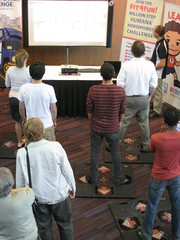 Image by Awesome Inc. via FlickrElizabeth Lyons newest paper from MSSE. Looking at the abstract it's great to see a comparison against game types in so many adults n=100.
Energy Expenditure and Enjoyment during Video Game Play: Differences by Game Type
Abstract
Purpose: Play of physically active video games may be a way to increase physical activity and/or decrease sedentary behavior, but games are not universally active or enjoyable. Active games may differ from traditional games on important attributes, which may affect frequency and intensity of play. The purpose of this study was to investigate differences in energy expenditure and enjoyment across four game types: shooter (played with traditional controllers), band simulation (guitar or drum controller), dance simulation (dance mat controller), and fitness (balance board controller).
Methods: Energy expenditure (METs) and enjoyment were measured across 10 games in 100 young adults age 18-35 yr (50 women).
Results: All games except shooter games significantly increased energy expenditure over rest (P < 0.001). Fitness and dance games increased energy expenditure by 322% (mean ± SD = 3.10 ± 0.89 METs) and 298% (2.91 ± 0.87 METs), which was greater than that produced by band simulation (73%, 1.28 ± 0.28 METs) and shooter games (23%, 0.91 ± 0.16 METs). However, enjoyment was higher in band simulation games than in other types (P < 0.001). Body mass-corrected energy expenditure was greater in normal weight than in overweight participants in the two most active game types (P < 0.001).
Conclusions: Active video games can significantly increase energy expended during screen time, but these games are less enjoyable than other more sedentary games, suggesting that they may be less likely to be played over time. Less active but more enjoyable video games may be a promising method for decreasing sedentary behavior.

Subscribe to:
Posts (Atom)


 Posts
Posts


