Showing posts with label research. Show all posts

Thursday, 20 December 2012

Exploring Unknowns with Exergaming

I had written this a little while ago, but the sentiment is still valid and at this time of goodwill, sharing, friendship and helping others, I thought it was particularly relevant to post.


Unusually for an article about exergaming we are starting outdoors. At 3,500 feet to be precise. Like many of us I am comfortable with flying as a means of transport. I also enjoy flying as a pastime having earned my wings some years back qualifying to pilot light aircraft. At few thousand feet in this Cessna, I am neither comfortable nor enjoying the flight. I feel cold, I feel apprehensive, I feel unsure, I feel not in control. The once familiar rolling green countryside passing below no longer looks picturesque, it looks menacing and alien. With a cacophony of noise and blast of cold air, the side of the Cessna opens up, and I find myself at the open door, gripping the aircraft for fear of falling out. Over the noise of the engine and the roar of the slipstream I hear myself questioning how I got in this situation, how this looks like a really long way down, how I wished I was not here, uncertain of what will happen, what could happen, what to do. Then I jumped.

The members of The Exergame Network successfully raised $350 for me to take on this challenge of a solo skydive to raise money for much needed exergame research. The Exergame Network (TEN) is a non-profit, unaffiliated and unbiased group of individuals with a common goal, to advocate the appropriate use of exergaming to improve health and fitness. The group started from an expansion in interest of the genre of exergaming and a need to continue the debates between that of the annual Games for Health conferences in Boston. TEN created resources, such as the TEN wiki, and used collaboration tools such as Skype and Google Docs to advance understanding and structure thinking around exergaming.

The work of TEN led to identification that exergaming in practice was progressing far faster than research could keep up. Members of the network identified what these gaps are, from creating and analysing an evidence base of published studies on it’s wiki. We then established what progressive research questions could be asked in order to get “what we can prove” in line with “what we know”. Closing this gap is a priority for the advocacy of TEN.

In order for TEN to close this gap we are pulling together resources from its members to arrive at a package of awards that can be granted to aid the inception and completion of the missing studies. My skydive was just a part of this package, raising money that will be used for buy out from class or research assistant’s time. With a strong contingent of established researchers, academic and clinicians the awards package also includes free consultancy time to aid newcomers. This experience in exergaming provides a big advantage in the methodology and study design.

There is also a wealth of exergaming manufacturers, distributors and implementers within the TEN network that alongside pledges of free consultancy for the award package are able to donate or loan exergaming equipment to facilitate studies. We even have members who are pledging facilities, and in some instances with populations already pre-engaged in exergaming.

Completing the awards package we have pledges of dissemination opportunities that include a pre-agreed poster session and a journal publication (subject to editorial controls). When this package of awards is finalised in the new year a panel from TEN will be inviting submissions for study proposals which will answer our research questions and fill the gap between theory and practice. Successful applications will receive the awards that aid the complete process from design to publication.

Completing this project has significant outcomes. For the people “at the coal face”, supporting, promoting and implementing exergaming the publication of studies that confirm what we are telling people about exergaming will be the evidence basis to help progress the genre. For the academic community the seeding of studies in exergaming will enable more progressive research to be carried out, and give a foundation for researchers beyond simple energy expenditure studies.
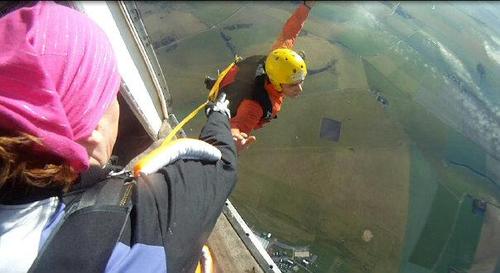


Where does that leave me? Like the state of exergaming research today, I am hanging in limbo, under a parachute canopy. I soon realise there is a problem. My canopy lines are twisted and the parachute is not controllable. From the instruction of the course I know what I need to do to resolve the problem and I follow the advice to separate the risers and kick out of the twists. Under full control I can clearly see the direction I need to take and maneuver for the landing pattern. Having the advantage of experience from my fixed wing qualifications it is easy for me to fly the pattern and bring the canopy onto final approach. As I come in to landing I have a talk-down via radio to ensure my pre-landing checks are correct. Resisting the natural temptation to slow the canopy I approach on “full drive”, flaring at the right time and right height to make a successful landing.

As I walk alone back to the manifest area I realise that the success of the jump was down to having the right information to start with, the application of experience to a new environment and the continual support and guidance throughout the final landing phase. This is comparable to the experience TEN will be providing for researchers and students willing to take a leap of faith into the genre of exergaming research.


Originally posted at http://gamercize.blogspot.com/2012/12/exploring-unknowns-with-exergaming.html

Friday, 16 November 2012

Jumping into Exergaming Research

The Exergame Network is a not for profit advocacy group promoting exergaming that wishes to give students new opportunities in research. On November 18, Richard Coshott, Chairman, will be taking a literal leap of faith to launch a new initiative.

PRLog (Press Release) - Nov 16, 2012 -
Coshott will be going through two days training towards a solo skydive to support and raise money for the exergaming movement. The Exergame Network (TEN) will use the funds collected through this fundraiser to support new generation researchers with their study costs into active gaming and exergaming.

TEN has been long aware that the limitations of exergaming are public knowledge, dissemination and evidence base rather than failings of exergaming equipment or the individuals who deliver the experiences. To address this TEN has collaborated to identify the top research questions, and therefore evidence, required to understand exergaming.

Coshott is hoping that more research will help bring exergaming to the forefront.
“There a is a widening gap between what we know and what we can prove. Research is stuck in Exergaming 101 with energy expenditure studies. The collaboration of academics and deliverers of exergaming within TEN has explored the practice and theory, concluding there isn’t enough quality research that answers the questions that we want answered,” Coshott said.
Shellie Pfohl, President's Council on Fitness, Sports & Nutrition at USF, FL


There are several studies that need to be funded. These studies fall into the following categories: positive behavior effects, gateway effect and comparative enjoyment, health benefits, family health benefits, cognitive and improved social confidence through exergaming.

For these categories, TEN will be providing a package of incentives including cash for research assistants or buy out from classes, exergaming equipment donations and loans, use of exergaming facilities, dissemination opportunities at conferences, publication opportunities and professional and academic expertise.

For more information about exergaming and to get involved with a pledge, visit http://www.facebook.com/groups/exergaming/ or follow the movement on Twitter at https://twitter.com/ExergameNetwork.

To donate to the cause, visit: https://www.fundraise.com/

Thursday, 8 November 2012

Pledges for Exergaming Research


The Exergame Network is running an initiative to help bring new researchers into the field of exergaming. See the page on our wiki site that outlines this project - http://exergaming.pbworks.com/w/page/54632210/Exergaming%20Funding

In order to make exergaming an attractive proposition as a field of study we are reaching out to the network and exergamers world wide to pledge resources. Any help you can give is great, it could be as little as an hour on Skype with a student to fine tune a research question or as much as donation of exergaming equipment to be the subject of a study! You can make your pledges here : http://www.surveygizmo.com/s3/1081349/Resource-Pledges-for-Exergaming-Research or complete the form below:

Thursday, 15 March 2012

AAHPERD Exergaming Presentations - TEN has the Power

There are two pages of academic presentations and poster session on the subject of exergaming at the AAHPERD Nationals in Boston this year. Sadly Boston is experiencing power issues that shut down the conference yesterday and are likley to impact today's proceedings.

TEN will help presenters disemminate their studies and ideas by publishing them on The Exergame Network slideshare profile (http://www.slideshare.net/ExergameNetwork) and futher social media distribution via Twitter and Facebook.

If you have an exergaming presentation that has been cancelled, please email info@exergamenetwork.org with a link to your session outline on the AAHPERD site (for example http://aahperd.confex.com/aahperd/2012/webprogram/Session52322.html) and attach a copy of your presentation or poster. TEN will do the rest for you!

Sunday, 12 February 2012

The Exergame Network in 2012

The Exergame Network (TEN) is taking new focus into 2012 to explore the various aspects of how exergaming affects peoples lives. The achievements of TEN in 2011 have been without parallel in the exergaming sector. As a non-profit, non-affiliated, international group that has no funding or strict organisational structure TEN operates only through the passion of individuals and on the generosity of these expert's time. If you do not know what TEN has achieved, take a look at the slides below;


Exergaming has much to do with change and progression, TEN is changing and progressing with a new format for 2012. The first collaborative Skype call of the year outlined those changes;
  • TEN is moving towards delivery focused collaboration in Workshop Skype Calls
  • TEN will still maintain it's social support collaboration, with open general discussion calls
  • Responsibility for running the TEN social channels (Twitter, Facebook etc) will be expanded
  • Projects will be focused to interest groups and collaboration will be largely online in real-time
  • TEN will branch out the representation of Exergaming into pure gaming and pure health channels
  • TEN will maintain links with games for health channels
  • TEN's International focus will take account of regional expert bases, adapting to fit
  • TEN will remain a free unbiased collaboration, with an executive steering group based on participation
TEN brings the commercial, academic and public passions for exergaming under one roof, the democratically decided motto of the network is as it does - "Promoting Healthy Exergaming Worldwide"


Tuesday, 13 September 2011

When Good Exergaming Research Goes Bad

Another Exergaming related study deriving inconclusive results based on an incorrect premise: http://www.ncbi.nlm.nih.gov/pubmed/21353635


The Abstract of the study points out 4 activities, 2 of which require significant aerobic capacity. The conventional aerobic activity was 'running' (verb) on a 'treadmill' (equipment/noun), the other was referred to as an Exergame? What Exergame and what physical activity or activities were required by the Exergame?!

Exergaming is a genre, a methology. Exergames vary as much as any other physical activity. This is akin to saying "I did sport the other day", the immediate response to that is "What sport did you do?". So what was the Exergame, was it chosen completely randomly, was it meant to also replicate running, was it a highly cognitive exergame such as DDR or iDANCE etc etc.

The complete study may well point out the exact nature of the Exergame used, but it is obvious to the researchers that this fact is of little importance in summing up their findings. This is extremely irksome, as they DO stipulate the nature of the conventional aerobic activity! (they also leave out the nature and platform required of the seated videogame).

This is simply inequitable and unfortunately, all to annoying common. Quite obviously the researchers misunderstand 'what is an Exergame'. This is misinformed at best and incompetent at worst. This is further exemplified in their conclusion and significance, "....exergames..may not exert the same benefits..", again which Exergame was used? From this, the conclusion would change to "....XXX Exergame ..may not exert.....". Extrapolating the results of 'one' Exergame does NOT predict an outcome for ALL Exergames!

All Exergames are NOT equal, of course not, why on earth would they be! In the same way as not all sports, video games, fitness equipment etc are 'the same' or 'produce or require the same responses'. This is a gross and insipid generalisation.

The massive cross section of Exergames available today all 'require' different and sometimes unique physical, cognitive, social, emotional, logical, musical etc abilities. Exergames can engage specific, local or compound muscle groups; lower limb movement, limb extremeties, upper limbs only, combinations of both, full body along with running, jumping, twisting, stepping, punching, dancing, and so on......

Please researchers, we encourage you to pour your expertise into this rapidly developing genre. The research potential here is massive, but get your facts straight on Exergaming. For a lesson in Exergaming 101: http://exergaming.pbworks.com/

The Exergame Network (TEN) is a not for profit advocacy resource that is dedicated to getting the best out of exergaming.  Resources relevant to this post are TEN's Rating System (TRS) and the Researcher's Resource. Details of both projects can be found on our wiki.

The Researcher's Resource project in particular highlights studies that exhibit either very good or very poor design and/or exergaming understanding from the researcher. The product of this resource will be the Top 10 exergaming studies, to show researchers "What good looks like" and to bring out the best of exergaming implemention to the public eye.

Tuesday, 25 January 2011

Study: Exergaming shown as an effective tool for engaging PE Students

Research undertaken at the University of South Florida Active Gaming Research Lab in Belle Witter Elementary, FL, has been published in the Journal of Applied Behaviour Analysis demonstrating how exergaming may be able to motivate hard-to-reach kids in PE.

The study was lead by Victoria Fogel, MS in an Active Gaming (exergaming) room set up by Dr. Lisa Hansen in 2008, examining “inactive” children’s behavioral responses to exergaming. The data collected included the physical activity of the kids while using exergames in class and contrasts this with regular PE lessons.

The results demonstrated that exergaming produced substantially more minutes of physical activity and more minutes of opportunity to engage in physical activity than did the standard PE lesson. When exergaming the student showed an average of 9.2 min of physical activity per session, while in the PE class they achieved a lower 1.6 min average of physical activity.

The publication of this study adds to the evidence base supporting the appropriateness of using exergaming in the physical education classroom. Because many different exergaming activities were involved in this study, the results show the variety of the genre and the ability of exergames to engage kids. The study can be accessed via PDF download at The Exergaming Network’s wiki site, filed under Exergaming Evidence Base, here.

USF’s College of Education uses the Active Gaming Labs not only for research, but also to demonstrate modern, innovative physical activity approaches to future PE teachers, government departments, and health specialists. Representatives from The President's Council for Fitness, Sports and Nutrition recently visited the research facilities; click here for videos of the exergames in action.

Friday, 31 December 2010

Study: Xbox is better exercise than Wii

Active Gaming Proved To Keep Kids Interested

Two major criticisms of using active gaming for physical activity are the lack of exercise compared to traditional activity and the expectation that kids easily
get fed up with the new way of moving.


Two linked studies in the United Kingdom have tackled these issues head-on by trialling active gaming in a free-play environment. Two schools in the Midlands undertook a medium term study using popular active games compared against free play in the playground.


The effort that the kids expended was converted into “steps” to make the results comparable between the playground and the video games. The initial study, over six weeks used Nintendo Wii Sports active play compared with the baseline of traditional play. The results showed that in week one the Wii was king of the calories, keeping kids 25% more active than the playground.


After the first week, the criticisms of boredom and poor exercise appeared well founded, as Wii exercise floundered to a poor 65% of traditional activity. The study was then repeated, this time using Xbox and Gamercize Power Steppers. The results, unexpectedly, turned the thinking about the shortcomings of active gaming on its head.


For the second data collection, the kids had to keep moving on the Gamercize steppers to power their controllers and play the game, which would pause if they stopped moving. Normal video games are compatible with Gamercize and games such as Lego Star Wars and FIFA were used.


The Gamercize results were similar to Nintendo’s results for week one, reflecting the kids excitement of “something new”. What happened next was unexpected. Rather than the initial interest tailing off like it did with Wii, the combination of Xbox and Gamercize kept the kids playing, engaged and active throughout the entire study period.


The Wii data supported the loss of interest and lack of exercise critisims of active gaming, but Gamercize for Xbox did not suffer a lack of interest over time or a drop in physical activity. What can we conclude from this? As a physical activity intervention, Gamercize uses the attraction of videogames to keep the kids engaged and the patented Gamercize approach of minimal interaction kept the kids active the whole time.


Results of the Gamercize study have been presented at the European Child Obesity Group. Reference: Duncan, M. J., Birch, S., Woodfield, L., Hankey, J. (2010) An evaluation of a 5-week, school-based, exergaming intervention using the Gamercize power stepper on body mass index and physical activity during school lunch breaks in British primary school children. Proceedings of the 20th Annual Workshop of the European Child Obesity Group, Nov 17-20th, Brussels, Belgium.