
Showing posts with label study. Show all posts
Showing posts with label study. Show all posts
Thursday, 1 November 2012
PhD Defense: Comparing MVPA, EE, RPE, & Enjoyment in Adolescents Playing Exergames
A couple of weeks ago I defended my dissertation titled: "Comparing MVPA, Duration, EE, RPE & Enjoyment of Adolescents Playing Exergames". I would like to thank everyone who has been so helpful and instrumental in getting me to this point, especially my Committee Chair Dr. Melissa Bopp; Committee Members: Dr. Linda Caldwell, Dr. R. Scott Kretchmar, Dr. Karl Newell; and Dr. John Challis (former Grad Coordinator) all of Penn State University; PSU & SUNY Cortland Faculty and Staff; the Cortland YMCA staff and participants, and of course my wonderful and loving family. Some of the details have been omitted as the separate papers are in the process of being submitted to separate journals but it gives you a rough estimate of what I was investigating. If you have any questions please feel free to contact me.


Monday, 24 October 2011
Playing exergames in the classroom: Pre-service teachers’ motivation, passion, effort, and perspectives (study)
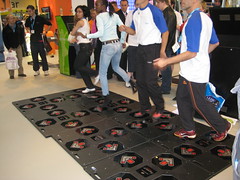 Image by BeFitt via FlickrThis study investigated pre-service teachers’ experience, motivation, passion, effort, and perspectives in playing exergames in the classroom using the self-determination theory as the main theoretical framework. One hundred forty pre-service teachers participated in the study. A mixed method was used. Data included pre-survey and post-survey results and classroom observation notes. Findings indicated that most pre-service teachers had little prior experience in exergames. However, they enjoyed playing exergames in the classroom and considered it beneficial to incorporate exergames in teaching. They also raised concerns, challenges, and the need for resources to effectively incorporate exergames in teaching. Findings also suggested that promoting pre-service teachers’ higher levels of self-determined motivation and harmonious passion may motivate them to be more active in exergames. Details are discussed in the paper.
Journal of Technology and Teacher EducationISSN 1059-7069Volume 19, Issue 3, October 2011Association for the Advancement of Computing in Education (AACE) Chesapeake, VA
Click here to explore more of ExerGame Lab's archived posts involving research studies.

Wednesday, 19 October 2011
Vigorous Physical Activity in Dance Exer-Game (study)
 Image via WikipediaHere's a new article invloving adults playing from the ADAM lab on Long Island
Vigorous Energy Expenditure with a Dance Exer-game. JEPonline 2011;14(4):13-28.
Physical inactivity is a risk factor for heart disease, diabetes, and obesity. Efforts to increase physical activity can include active video games. While many active video games demonstrate exertion levels commensurate with light to moderate exercise, it is unclear whether these games can meet requirements for vigorous activity. The purpose of this study was to determine whether the active videovgame, Dance Dance Revolution (DDR), can provide vigorous exercise vin a wide range of adults. Twelve adults (18 to 53 yrs, BMI 18 to 37) were studied while playing DDR at an advanced level. Metabolic measures were collected during a 30 min game-play protocol at the advanced “Heavy” level of difficulty. Mean values achieved were the following: 8 METs, heart rate 157 beats·min-1, and energy expenditure 9 kcal·min-1. DDR is played similarly to that of interval type exercise where each game-song is followed by a brief rest period. Subjects reported that DDR is fun, and that the competitive nature of playing with others is enjoyable. This study found that DDR is effective in meeting vigorous physical a requirements for improving or maintaining physical fitness.
Click here to explore more of ExerGame Lab's archived posts involving research studies.

Saturday, 17 September 2011
Energy Expenditure and Enjoyment during Video Game Play: Differences by Game Type (study)
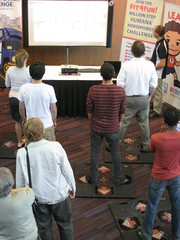 Image by Awesome Inc. via FlickrElizabeth Lyons newest paper from MSSE. Looking at the abstract it's great to see a comparison against game types in so many adults n=100.
Energy Expenditure and Enjoyment during Video Game Play: Differences by Game Type
Abstract
Purpose: Play of physically active video games may be a way to increase physical activity and/or decrease sedentary behavior, but games are not universally active or enjoyable. Active games may differ from traditional games on important attributes, which may affect frequency and intensity of play. The purpose of this study was to investigate differences in energy expenditure and enjoyment across four game types: shooter (played with traditional controllers), band simulation (guitar or drum controller), dance simulation (dance mat controller), and fitness (balance board controller).
Methods: Energy expenditure (METs) and enjoyment were measured across 10 games in 100 young adults age 18-35 yr (50 women).
Results: All games except shooter games significantly increased energy expenditure over rest (P < 0.001). Fitness and dance games increased energy expenditure by 322% (mean ± SD = 3.10 ± 0.89 METs) and 298% (2.91 ± 0.87 METs), which was greater than that produced by band simulation (73%, 1.28 ± 0.28 METs) and shooter games (23%, 0.91 ± 0.16 METs). However, enjoyment was higher in band simulation games than in other types (P < 0.001). Body mass-corrected energy expenditure was greater in normal weight than in overweight participants in the two most active game types (P < 0.001).
Conclusions: Active video games can significantly increase energy expended during screen time, but these games are less enjoyable than other more sedentary games, suggesting that they may be less likely to be played over time. Less active but more enjoyable video games may be a promising method for decreasing sedentary behavior.

Wednesday, 13 July 2011
Exergaming Research for Everyone

Over the past month The Exergame Network has been working on a new concept, to take Exergaming research out of the journals and put it in front of the public. The project has been the subject of two TEN Skype calls so far and work has begun on TEN's Wiki.
The first call started with the brief; Build an evidence base of exergaming research and define studies that are missing
On the first call we had exergame manufacturers and distributors put forward "wish-lists" that they would like to see covered by the research community. The purpose being to give prospective users of exergaming an applicable evidence base of what would work well form them.
The researchers explained some of the difficulties around copyright, non-disclosure and funding to people on the call. They also explained some of the limitations that create the gap between what is required and what is possible at the moment, as well as the skills gap in exergaming experience.
During the call it became obvious that there was not only a need to build an evidence base for exergaming users, but also put together a resource of key exergaming studies that would inform and lead future research projects. It was decided to use the TEN Wiki as the method of collaboration in the first instance.
Projects that TEN undertake are open and transparent, which is an important consideration to give subsequent media releases credibility and satisfy the public's desire for unbiased and uncompromising information. Of course, projects that are open in nature tend to take a little longer, but we think that's worth it!
The Researchers Resource is being built on the Wiki at http://exergaming.pbworks.com/Exergaming-Evidence-Base for everyone to see. The key aspects of the research lists here are to show both good and poor research methods to give not just what's worth building on, but also to show what errors to avoid. At this stage it was noted that the TEN Rating System (TRS) will become a more and more useful resource for researchers in choosing appropriate exergames for the populations being studied.
This list will form the basis of the studies put forwards to the public as keynote research forming evidence for the best practices and best value outcomes. The public list itself was defined with the ais of being simple, clear and unclutter from academic jargon. The list is underway on TEN's Wiki at http://exergaming.pbworks.com/Helena. Clearly this is a working title!
The first call started with the brief; Build an evidence base of exergaming research and define studies that are missing
On the first call we had exergame manufacturers and distributors put forward "wish-lists" that they would like to see covered by the research community. The purpose being to give prospective users of exergaming an applicable evidence base of what would work well form them.
The researchers explained some of the difficulties around copyright, non-disclosure and funding to people on the call. They also explained some of the limitations that create the gap between what is required and what is possible at the moment, as well as the skills gap in exergaming experience.
During the call it became obvious that there was not only a need to build an evidence base for exergaming users, but also put together a resource of key exergaming studies that would inform and lead future research projects. It was decided to use the TEN Wiki as the method of collaboration in the first instance.
Projects that TEN undertake are open and transparent, which is an important consideration to give subsequent media releases credibility and satisfy the public's desire for unbiased and uncompromising information. Of course, projects that are open in nature tend to take a little longer, but we think that's worth it!
The Researchers Resource is being built on the Wiki at http://exergaming.pbworks.com/Exergaming-Evidence-Base for everyone to see. The key aspects of the research lists here are to show both good and poor research methods to give not just what's worth building on, but also to show what errors to avoid. At this stage it was noted that the TEN Rating System (TRS) will become a more and more useful resource for researchers in choosing appropriate exergames for the populations being studied.
This list will form the basis of the studies put forwards to the public as keynote research forming evidence for the best practices and best value outcomes. The public list itself was defined with the ais of being simple, clear and unclutter from academic jargon. The list is underway on TEN's Wiki at http://exergaming.pbworks.com/Helena. Clearly this is a working title!
The second skype call on the project focused more on getting some examples into the public list, and deciding on how to put this message across. The call was very much about "doing" rather than "talking" and members of the call started eagerly editing the wiki with ideas and information.
It was clear that the public facing list of exergaming research has some challenges ahead. On the call we talked about how to reference the studies, something very important in the academic world, but not of interest to the vast majority of the readers. We defined the target audience further, being anyone in the public domain that would not get this information from journals. This also includes members of the media, that often misreport research abstracts, typically with inappropriate headlines.
We also talked about referencing the actual exergame used, as this is a key factor in "making it real" for the reader, and for them to be able to take ideas forwards. This concept was universally accepted by commercial people and the academics on the call.
It was not all plain sailing, happy agreement though. The ideas around how to report (in the public list) the energy expenditures was a hot topic. One camp argued for the straight reporting right out of the research publication, while the other camp argued that this information needs to be simplified (as it is in public health promotion). There';s still some ground to cover on this subject!
Lastly, the call failed to conclude on who's studies / who's exergames should be reported in the public list. Of course in an ideal world, no one would be left out, but for an information piece we are trying to be concise while giving all the information relevant. This will be the subject of the next call this Friday, along with many more worked examples into the pubic list and plenty of "active discussion"!
Tuesday, 19 April 2011
Wii Fit Moves Women into Moderate Intensity Physical Activity - MPA (study)
 Image by WindRanch via Flickr
Cross-posted from ExerGame Lab:
In this recent Wii Fit study, researchers investigated the energy expenditure of young females across different game levels. Of course it makes sense that different levels will require different movements or more intense or more frequent movements, but until now there has been little in the area of level of game play and energy demands.
In this recent Wii Fit study, researchers investigated the energy expenditure of young females across different game levels. Of course it makes sense that different levels will require different movements or more intense or more frequent movements, but until now there has been little in the area of level of game play and energy demands.
Population: Adults (young female)
Number of Participants: n=8
ExerGame Software Title: Wii Fit
Games: Stepping and Hula
Levels: Beginner and Intermediate
Results: Highest energy expenditure and % of VO2 max at intermediate hula - but still in the moderate level of physical activity intensity MPA (~4.5 MET).


Points 2 Ponder (P2P)
- What does the hardest level look like in terms of VO2, METS, RPE, RER?
- Did the participants enjoy the games?
- Was their any correlation between enjoyment and perceived exertion?
- Would greater number of participants change the findings?
Worley, J., Rogers, S., & Kraemer, R. (2011). Metabolic Responses To Wii Fit™ Video Games At Different Game Levels Journal of Strength and Conditioning Research DOI: 10.1519/JSC.0b013e318207eae9

Saturday, 19 February 2011
Does IT Time Predict BMI in children and adolescents? (study)
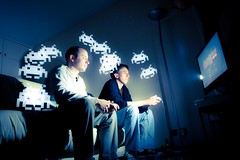 Image by gnackgnackgnack via FlickrDoes the time spent using Information Technology (IT) like using the computer, playing video games, and cell phone use predict BMI in children and adolescents? In a new study by Linda Jackson and Colleagues at MSU surveyed more than 400 children and adolescents (mean age 14 years old) over three years and found that IT and video game playing time did not predict BMI as other studies have indicated.
 Other results
- The more a participant played video games the better their visual-spatial skills were - which makes sense from all the work done especially in Dr. Bavelier's Lab in Rochester.
- Jackson et al found also found that video game playing time also predicted lower GPA which is interesting given the renewed interest in using serious games. I suppose the biggest difference is that I assume none (few) of the games these participants played were serious games, educational simulators, or exergames.
- Children who played videogames more had lower social self-esteem and grades than those who played videogames less.
Jackson, L., von Eye, A., Fitzgerald, H., Witt, E., & Zhao, Y. (2011). Internet use, videogame playing and cell phone use as predictors of children’s body mass index (BMI), body weight, academic performance, and social and overall self-esteem Computers in Human Behavior, 27 (1), 599-604 DOI: 10.1016/j.chb.2010.10.019

Tuesday, 25 January 2011
Study: Exergaming shown as an effective tool for engaging PE Students
 Research undertaken at the University of South Florida Active Gaming Research Lab in Belle Witter Elementary, FL, has been published in the Journal of Applied Behaviour Analysis demonstrating how exergaming may be able to motivate hard-to-reach kids in PE.
The study was lead by Victoria Fogel, MS in an Active Gaming (exergaming) room set up by Dr. Lisa Hansen in 2008, examining “inactive” children’s behavioral responses to exergaming. The data collected included the physical activity of the kids while using exergames in class and contrasts this with regular PE lessons.
The results demonstrated that exergaming produced substantially more minutes of physical activity and more minutes of opportunity to engage in physical activity than did the standard PE lesson. When exergaming the student showed an average of 9.2 min of physical activity per session, while in the PE class they achieved a lower 1.6 min average of physical activity.
The publication of this study adds to the evidence base supporting the appropriateness of using exergaming in the physical education classroom. Because many different exergaming activities were involved in this study, the results show the variety of the genre and the ability of exergames to engage kids. The study can be accessed via PDF download at The Exergaming Network’s wiki site, filed under Exergaming Evidence Base, here.
USF’s College of Education uses the Active Gaming Labs not only for research, but also to demonstrate modern, innovative physical activity approaches to future PE teachers, government departments, and health specialists. Representatives from The President's Council for Fitness, Sports and Nutrition recently visited the research facilities; click here for videos of the exergames in action.
Friday, 31 December 2010
Study: Xbox is better exercise than Wii
 Active Gaming Proved To Keep Kids Interested
Two linked studies in the United Kingdom have tackled these issues head-on by trialling active gaming in a free-play environment. Two schools in the Midlands undertook a medium term study using popular active games compared against free play in the playground.
The effort that the kids expended was converted into “steps” to make the results comparable between the playground and the video games. The initial study, over six weeks used Nintendo Wii Sports active play compared with the baseline of traditional play. The results showed that in week one the Wii was king of the calories, keeping kids 25% more active than the playground.
After the first week, the criticisms of boredom and poor exercise appeared well founded, as Wii exercise floundered to a poor 65% of traditional activity. The study was then repeated, this time using Xbox and Gamercize Power Steppers. The results, unexpectedly, turned the thinking about the shortcomings of active gaming on its head.
For the second data collection, the kids had to keep moving on the Gamercize steppers to power their controllers and play the game, which would pause if they stopped moving. Normal video games are compatible with Gamercize and games such as Lego Star Wars and FIFA were used.
The Gamercize results were similar to Nintendo’s results for week one, reflecting the kids excitement of “something new”. What happened next was unexpected. Rather than the initial interest tailing off like it did with Wii, the combination of Xbox and Gamercize kept the kids playing, engaged and active throughout the entire study period.
The Wii data supported the loss of interest and lack of exercise critisims of active gaming, but Gamercize for Xbox did not suffer a lack of interest over time or a drop in physical activity. What can we conclude from this? As a physical activity intervention, Gamercize uses the attraction of videogames to keep the kids engaged and the patented Gamercize approach of minimal interaction kept the kids active the whole time.

Results of the Gamercize study have been presented at the European Child Obesity Group. Reference: Duncan, M. J., Birch, S., Woodfield, L., Hankey, J. (2010) An evaluation of a 5-week, school-based, exergaming intervention using the Gamercize power stepper on body mass index and physical activity during school lunch breaks in British primary school children. Proceedings of the 20th Annual Workshop of the European Child Obesity Group, Nov 17-20th, Brussels, Belgium.
Subscribe to:
Posts (Atom)


 Posts
Posts


